|
Waterbirth
A
Gentle Beginning for a New Life
Article from the Waterbirth International WebSite
Most
people find great comfort and repose with water. Perhaps because
we begin our lives surrounded in liquid in the womb, this basic
familiarity stays with us throughout our lives. Human beings are
comprised primarily of water, and many special characteristics we
have link us to aquatic mammals, perhaps carrying the memory of
a time when the human species had an "aquatic interlude."
Human
beings' natural alliance with water is best witnessed in human babies
who can swim naturally and easily long before they learn to sit
up or crawl. During their first year of life, babies will calmly
and happily paddle underwater, gazing around with eyes wide open.
When they need to breathe, they naturally paddle toward the surface
of the water before taking a breath. Babies instinctively know not
to breathe while their heads are still submerged underwater. They
wait until they reach the surface of the water before breathing.
It seems to be only later that humans lose these instincts and become
more prone to drowning.
Soaking
in a tub of water to ease labor sounds inviting to most women. However,
laboring in water does more than merely relax and comfort the woman.
Resting in a warm tub of water actually facilitates the progression
of the latter stages of labor. Many women report a sensation like
an "energy surge" that moves through them as soon as they step into
the water. While a woman in labor relaxes in a warm pool, free from
gravity's pull on her body, and with sensory stimulation reduced,
her body is less likely to secrete stress-related hormones that
can slow or complicate labor. This allows her body to produce the
pain-inhibitors, endorphins, that ease her discomfort and facilitate
labor's progress.
The
hormones that are released during stress, noradrenaline and catecholamines,
actually raise the blood pressure and can inhibit or slow labor.
Dr. Serge Weisel presented his findings from a study of women laboring
in warm water in Belgium at the 1987 Pre & Perinatal Psychology
Association of North America conference. Weisel stated that women
with hypertension (high blood pressure) experienced a drop in blood
pressure between 10 to 15 minutes after entering a warm bath.
Being
more relaxed physically, a laboring woman is able to relax mentally.
Many women, midwives and doctors acknowledge the analgesic effect
of water. One obstetrical nurse who had a waterbirth described sitting
in a tub of warm water during labor as similar to "getting a shot
of demerol, but without the side effects." Others have referred
to the pool labor as "a wet epidural." Women achieve a level of
comfort in the water that in turn reduces their levels of fear and
stress. Women's perception of pain is greatly influenced by their
levels of anxiety. When labor becomes physically easier, a woman's
ability to calmly concentrate is improved, and she is able to focus
inward on the birth processes.
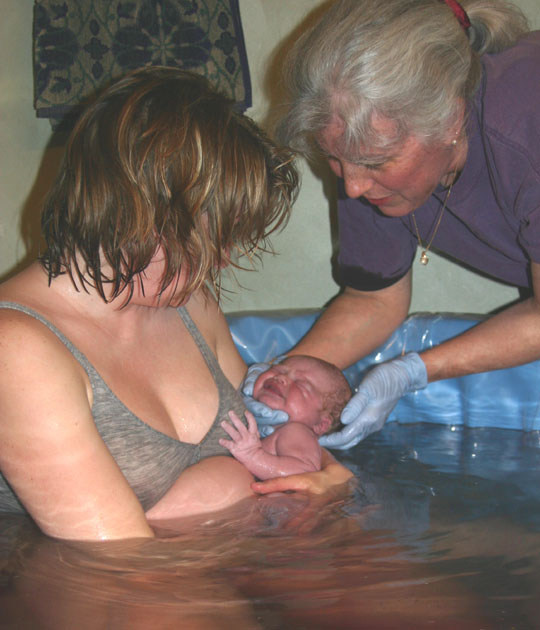
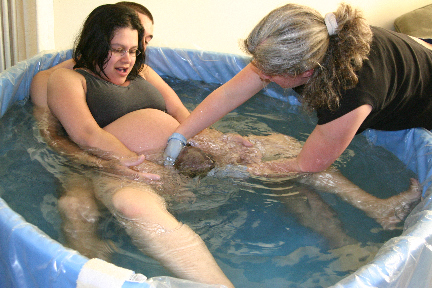
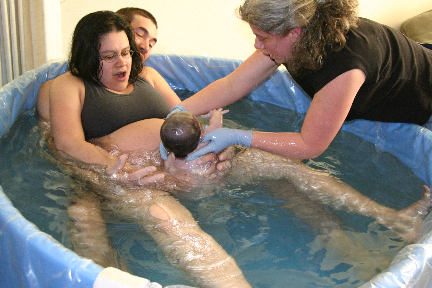
Joelle
has just given birth to her 3rd daughter, Callie.
Jan helps keep the baby's head out of the water.
Many
women report being better able to concentrate once they get into
the water. Doctors and midwives who attend waterbirths find that
the mere sight and sound of water pouring into the tub helps some
women release whatever inhibitions were slowing the birth, at times
so quickly that the birth occurs even before the pool is filled.
Oftentimes women get in the pool to labor and the birth happens
before they can get out of the pool.
Water
helps some women reach a state of consciousness in which their fear
and resistance are diminished or removed completely; then their
bodies relax, and their babies are born in the easiest way possible.
Mothers whose babies are born naturally in this way feel not only
relief at the end of their labor; even if exhausted, they often
feel exhilarated, ecstatic and euphoric from having experienced
their birth fully and in such a wonderful way, and knowing the baby
also has experienced little or no trauma! This is a positive result
unknown in hospitals not equipped for water birthing.
Another
benefit of waterbirth is the elasticity that water imparts to the
tissues of the perineum, reducing the incidence and severity of
tearing and the need for painful stitches or episiotomies. On the
occasion of his 100th water delivery, Michel Odent reported that
in the 100 waterbirths he had attended, there were no episiotomies
performed and only 29 cases of tearing, all of which were minor
surface tears. A 1989 nationwide survey published in The Journal
of Nurse Midwifery on the use of water for labor and birth reported
less incidents of perineal tearing with less severity.
The
ease of the mother who labors and gives birth in water becomes the
ease of the child who is born in the water, as well. Gentle alternatives
that make birth easier for the mother most likely will make birth
easier for the child. Their body responses are intricately linked.
While the child is in the womb and when he is passing through the
birth canal, the mother's experience influences the child's experience.
The emotions the mother feels can also be felt by the child because
the hormones her body secretes in response to her emotions are absorbed
by the child.
In
a medically controlled birth, any drugs or synthetic hormones that
the mother receives are also be received by the child. If the mother's
delivery is easy and smooth, so too is the child's birth. He spends
less time in the cramped birth canal and is free from the fear,
frustration or other painful emotions that a long and difficult
labor might arouse in the mother.
The baby emerges into the water and is "caught" either by the mother
herself or the birth attendant. In the water, the child has freedom
of movement within familiar fluid surroundings. A baby's limbs can
also unfold with greater ease during those first moments when he
leaves his mother's body and enters the water. The water offers
a familiar comfort after the stress of the birth, reassuring the
child and allowing his bodily systems time to organize.
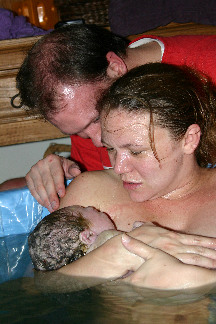
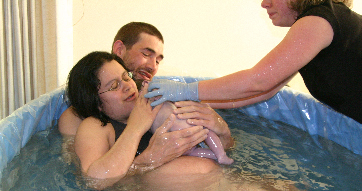
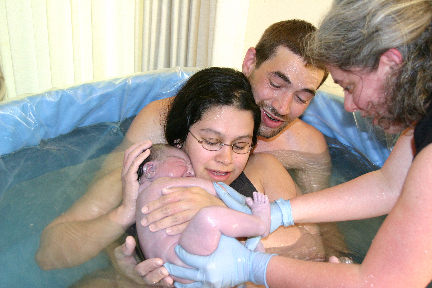
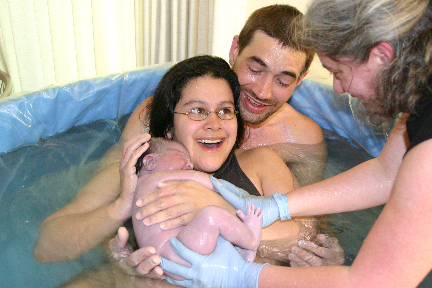
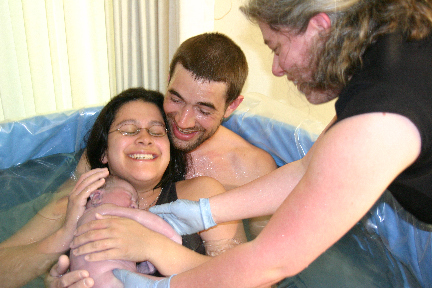
Alexis,
Michael, & newborn Gryphon, just moments old
During
the birth babies often open their eyes, move in all directions and
use their limbs. The shock and sensory overload that are so often
a part of conventional birth are diminished. Lights and sounds are
softer when perceived from under the water, and even the touch of
his mother's skin to his own tender skin is softened by the presence
of a familiar element: water.
Also,
in some cases, the mother may wish the entire family to be with
her during this very special time for everyone. This element of
water, familiar and secure for the baby, becomes comforting and
relaxing for the mother. The mother and baby together are profoundly
affected by this gentlest of gentle births.
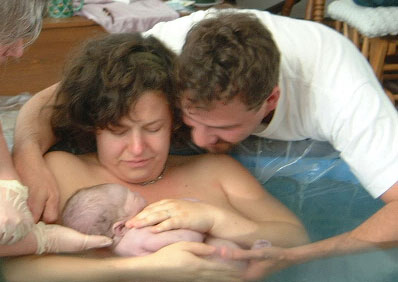
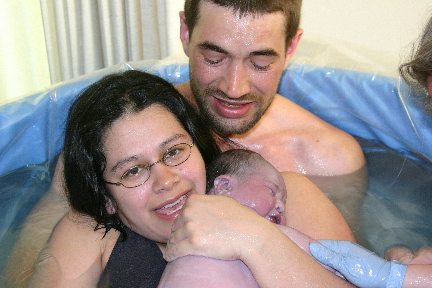
Nikki
and Fred discover their newborn son, River James.
Home
| About Us | Our
Philosophy | Homebirth | Doula
Care | Waterbirth | Belly
Art
Areas Served | Midwifery
Care | Links | Homeopathy
| Contact Us | Birth
Stories
|